Attic Mold Removal in Chicago
Remediation of attic mold from roof leaks and poor ventilation. We connect Chicago homeowners with vetted, licensed local pros, free.
Attic Mold in Chicago
Free, no obligation. We match you with up to two licensed, insured local pros so you can compare.
- Licensed pros
- Free, no spam
- One call, not eight
Got it. You are in good hands.
A vetted local pro will reach out shortly. For an active emergency, call us now at (813) 555-0911.
Chicago homeowners turn to attic mold removal after the storms that hit Cook County. Here is exactly what the work involves, what it costs, and how to get matched with a local pro.
Attic mold removal addresses fungal growth on roof decking, rafters, and attic insulation caused by roof leaks, inadequate ventilation, or HVAC condensation. The attic is one of the highest-risk mold zones in both Florida and Illinois homes because warm, humid air rises from living spaces and meets cooler roof decking - creating condensation on wood surfaces when ventilation is insufficient. In Florida, storm damage that compromises roof integrity even temporarily creates the moisture intrusion that feeds attic mold within days. In Illinois, ice dams in winter force meltwater back under shingles and onto roof decking, producing the same result. Because attic air is drawn into the HVAC system, mold colonies growing above the living space actively seed every room in the house until the source is remediated. Remediation addresses both the visible colony and the ventilation or moisture-entry defect that created the conditions.
When you need itSigns you need this service
- A roof inspection or routine attic check after a storm reveals dark staining, fuzzy growth, or visible mold colonies on rafters or roof decking
- A musty or earthy odor is strongest near ceiling vents, attic access hatches, or upper-floor rooms and does not resolve after airing out the space
- Air quality testing identifies elevated mold spore counts in upper-floor living areas without a visible mold source in those rooms
- A roof leak occurred and the attic was not dried out within 48 - 72 hours following the intrusion event
- An attic inspection reveals wet, compressed, or discolored blown insulation in areas beneath a roof penetration, chimney, or ridge
- A home inspector flags attic mold during a pre-sale inspection, requiring documentation of remediation to satisfy the buyer or lender
How it works
- Moisture source identification and roof assessmentBefore remediation begins, the moisture entry point must be identified. A contractor inspects the roof for damaged shingles, flashing failures, penetration leaks, or ridge vent damage. In Florida, storm damage is the most common culprit; in Illinois, ice damming and flashing failures are frequent drivers. Remediation performed before the moisture source is repaired will fail - new growth appears within weeks.
- Attic inspection, mapping, and testingThe remediation contractor or independent assessor documents the extent of visible growth, uses a moisture meter to map wet zones in decking and framing, and collects air and surface samples if not already performed. The inspection determines whether insulation is salvageable or must be removed, which drives a significant portion of the cost estimate.
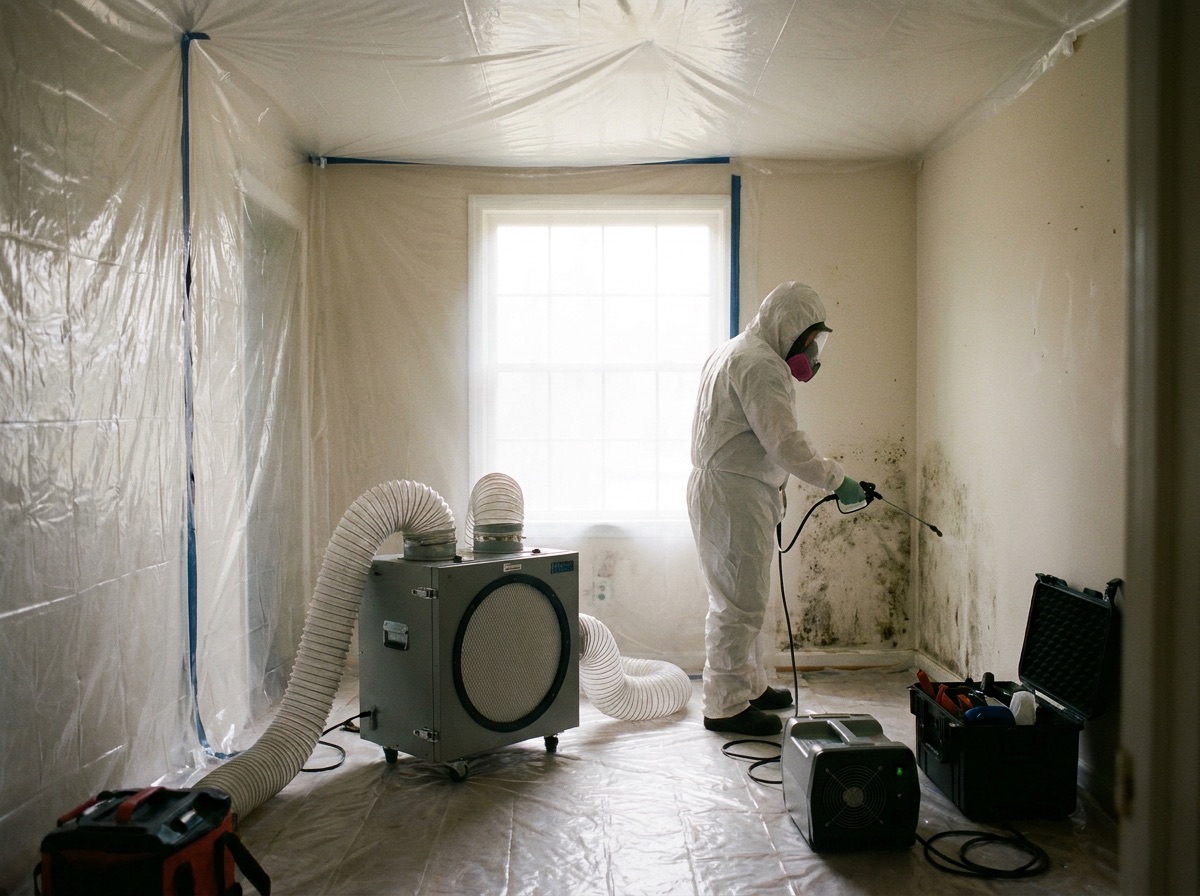
- Containment and attic ventilation controlThe attic access hatch and any HVAC return penetrations into the attic space are sealed with poly sheeting. HEPA-filtered negative air machines are positioned to draw air out of the attic and exhaust to the exterior, preventing spores disturbed during remediation from migrating downward through ceiling penetrations into living spaces. Ridge vents and soffit vents are temporarily blocked if necessary to maintain negative pressure.
- Contaminated material removalMold-contaminated insulation - whether blown fiberglass, cellulose, or batts - is vacuumed out or removed by hand and double-bagged for disposal. Contaminated insulation cannot be treated in place. Roof decking with active mold colonies is dry-ice blasted, wire-brushed, or sanded to remove the mold layer from the wood surface, followed by HEPA vacuuming of all debris.
- Antimicrobial treatment and encapsulationAll wood surfaces in the attic - rafters, decking, collar ties, and blocking - receive a thorough application of EPA-registered antimicrobial solution. After the dwell period, a borate-based or mold-inhibiting encapsulant is applied to all treated wood surfaces. The encapsulant seals residual mycotoxins, inhibits future colonization, and provides a documented treatment layer visible during any future inspection.
- Insulation replacement, ventilation correction, and clearance testingAfter a written clearance from an independent air sampling test, new insulation is installed to the appropriate R-value for the climate zone. Ventilation deficiencies - blocked soffit vents, inadequate ridge ventilation, or improperly terminated bathroom exhaust fans dumping humid air into the attic - are corrected as part of the project close-out to prevent recurrence.
What it costs
Attic mold remediation in Florida and Illinois typically runs $1,500 - $3,500 for smaller attics under 500 square feet where mold is confined to a single section of decking and insulation is not heavily contaminated. Medium attics of 500 - 1,000 square feet with more widespread growth average $2,500 - $5,000. When structural damage to rafters or decking requires carpentry work alongside remediation, or when the full attic requires insulation removal and replacement, total project costs can reach $5,000 - $10,000 or more. Insulation replacement alone adds $1.50 - $3.50 per square foot depending on type and R-value.
Attic Mold in Chicago: questions
Do you offer attic mold in Chicago?
Yes. We connect Chicago homeowners with vetted, licensed local pros for attic mold removal, with a free assessment and no obligation.
How fast can someone help with attic mold in Chicago?
For Chicago and the surrounding Cook County area, our network pros prioritize storm work and typically respond same-day or next-day for urgent needs.
What causes attic mold after a storm in Florida?
Florida storm events most commonly cause attic mold through two mechanisms: direct roof penetration (storm-lifted shingles, cracked flashing, or puncture damage that allows rain to wet decking and framing) and power-outage-related HVAC failure. When air conditioning is off for days after a storm, indoor humidity climbs rapidly and humid air migrates into the attic through every ceiling penetration - ceiling fixture boxes, recessed lights, and attic access hatches are all pathways. The combination of heat, humidity, and any residual moisture from the storm creates ideal mold germination conditions within 48 - 72 hours.
What causes attic mold in Illinois homes?
In Illinois, the primary drivers are ice dams and bathroom or kitchen exhaust fans terminated into the attic rather than to the exterior. Ice dams form when heat escaping from living spaces melts snow at the roof center; the meltwater refreezes at the cold eaves and backs up under shingles, wetting decking and insulation. Exhaust fans terminating into the attic dump warm, moisture-laden air directly onto cold roof decking for years, producing chronic wood moisture levels that support mold growth even without a discrete leak event.
How do I know if I have attic mold without going into the attic myself?
Common indirect indicators include a persistent musty odor strongest near ceiling vents or the attic access hatch, unexplained increases in allergy or respiratory symptoms among occupants of upper-floor rooms, visible staining on the attic side of the access hatch or around recessed ceiling fixtures, and elevated indoor mold spore counts identified by a licensed assessor's air sampling. If you've had a confirmed roof leak, assume attic moisture entry occurred and commission an inspection - early detection dramatically reduces remediation scope and cost.
Does attic mold affect indoor air quality in the living spaces below?
Yes, actively. Attic air is not isolated from living space air. Thermal convection draws attic air downward through ceiling penetrations, and if the HVAC system's air handler is located in the attic - common in Florida homes - return air actively pulls mold spores from the attic into the air handling unit and distributes them through every supply duct in the house. Elevated mold spore counts measured in living spaces without a visible mold source in those rooms frequently trace back to an attic colony.
Does the roof need to be repaired before or after attic mold remediation?
The roof penetration or leak source must be repaired before remediation, not after. If active moisture entry is ongoing during treatment, the antimicrobial and encapsulant applications are compromised by continued wetting, and mold regrowth is inevitable. The standard protocol is: repair the roof first, allow the attic to dry to below 16% wood moisture content, then perform remediation. If a roof repair creates a timeline conflict, temporary tarping of the affected roof section is an acceptable interim measure while remediation is scheduled.
Can attic mold be remediated without removing all the insulation?
It depends on the type and extent of insulation contamination. Insulation that has been directly wetted by roof intrusion and shows visible mold or is compressed and discolored must be removed - you cannot effectively treat mold through a foot of insulation, and contaminated insulation itself is a mold substrate. Insulation in areas remote from the water entry point that is dry and unaffected can often be preserved. The contractor will assess this zone by zone during the inspection phase.
How long does attic mold remediation take?
Most residential attic mold remediation projects take one to three days for the physical work - containment setup, insulation removal, wood treatment, and encapsulant application. After the work is complete, the containment is left in place while treated surfaces dry, typically overnight. An independent assessor then collects post-remediation air samples, which require one to three additional days for laboratory results before a clearance letter is issued. Insulation replacement and any carpentry work are typically scheduled after clearance.
What is dry-ice blasting and when is it used for attic mold?
Dry-ice blasting propels small pellets of solid CO2 at high velocity against mold-colonized wood surfaces. The impact removes the mold layer through a combination of mechanical abrasion and the rapid thermal shock of the dry ice sublimating on contact. It is preferred over sanding for attic decking because it leaves no secondary residue to clean up - the dry ice turns to gas - and does not introduce water or solvents onto wood that needs to remain dry. It is more expensive than sanding but produces a cleaner, more complete mold removal on rough-sawn dimensional lumber.
Is attic mold remediation covered by homeowners insurance?
When attic mold is directly caused by a covered storm event - wind-driven rain through a damaged roof, for example - most homeowners policies cover remediation as a component of the broader storm damage claim, subject to your deductible and any mold coverage sublimits in your policy. Attic mold resulting from long-term poor ventilation, chronic ice damming without a discrete storm event, or exhaust fans terminated into the attic is typically categorized as a maintenance issue and excluded. Document the connection between the storm event and the moisture entry point clearly, including dated photos and a contractor's written findings.
What ventilation corrections should happen after attic mold remediation?
Standard corrections include: extending any bathroom or kitchen exhaust fans that terminate in the attic to properly discharge through a roof or soffit vent cap; clearing blocked soffit vents of insulation or debris that has restricted intake airflow; ensuring the net free vent area meets the 1:150 or 1:300 ventilation ratio standard for the attic square footage; and confirming that the ridge vent is unobstructed. These corrections are not optional add-ons - they are the structural prevention step that makes the remediation investment durable.