Ceiling Water Damage Repair in Miami
Drying and repair of water-stained, sagging, or collapsed ceilings from roof or plumbing leaks. We connect Miami homeowners with vetted, licensed local pros, free.
Ceiling Water Damage in Miami
Free, no obligation. We match you with up to two licensed, insured local pros so you can compare.
- Licensed pros
- Free, no spam
- One call, not eight
Got it. You are in good hands.
A vetted local pro will reach out shortly. For an active emergency, call us now at (813) 555-0911.
Miami homeowners turn to ceiling water damage repair after the storms that hit Miami-Dade County. Here is exactly what the work involves, what it costs, and how to get matched with a local pro.
Ceiling water damage is often the first visible evidence of a problem that has been developing unseen for longer than homeowners realize. In Florida, roof leaks from hurricane winds, missing shingles, and flashing failures are the dominant cause - humid subtropical conditions accelerate hidden moisture damage and mold growth inside ceiling assemblies once water has entered. In Illinois, ice dams forming at roof eaves during freeze-thaw cycles drive meltwater under shingles and into ceiling assemblies, while plumbing leaks from second-floor bathrooms or HVAC condensate line failures are year-round risks. The repair involves more than cosmetic patching: the water source must be confirmed as resolved before any drywall work begins, the ceiling assembly must be dried to normal moisture content, and all damaged drywall - including hidden wet sections that appear dry on the surface - must be replaced. Stain-blocking primer and matched texture are required to produce a lasting, invisible repair.
When you need itSigns you need this service
- A visible brown or yellow water stain has appeared on a ceiling after a rain event, storm, or plumbing leak
- The ceiling surface is bubbling, blistering, or the paint is peeling in a localized area
- The ceiling is sagging or has a visible bulge, which indicates water is pooling above the drywall
- Water is actively dripping from the ceiling, particularly near a light fixture or ceiling fan
- A musty odor is emanating from the ceiling area, suggesting mold growth inside the assembly
- Prior ceiling repairs have been painted over without addressing the source leak, and staining has returned
How it works
- Source identification and leak confirmationNo ceiling repair is durable unless the water source is resolved first. Technicians inspect the space above - crawl space, attic, or upper-floor bathroom - to identify the active or previous leak path. Roof leaks, failed plumbing supply or drain lines, HVAC condensate overflows, and ice dams produce different damage patterns that each require different upstream fixes. The source is confirmed as resolved before any drywall or cosmetic work begins.
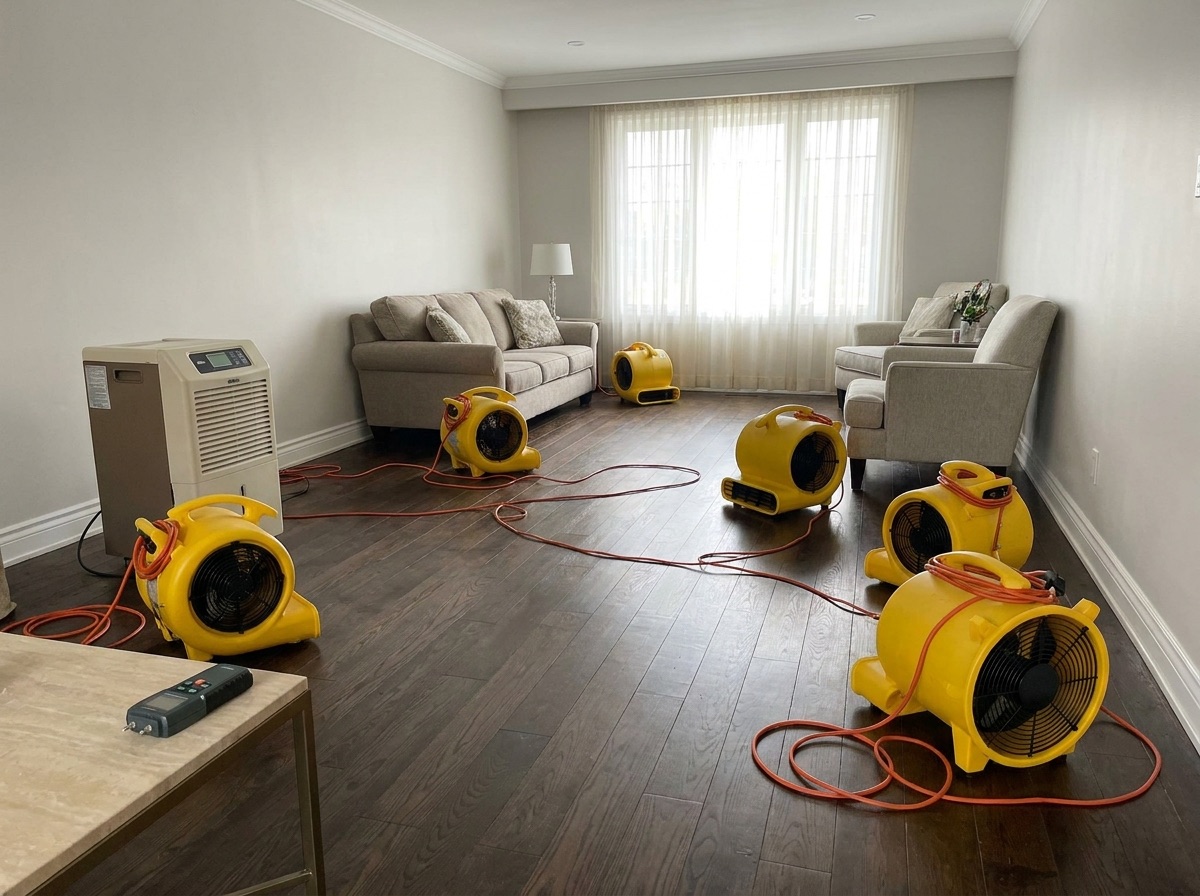
- Moisture assessment and drying of the ceiling assemblyThermal imaging cameras and calibrated moisture meters map the wet zone in the ceiling drywall, insulation, and any framing above. If the source has been stopped and moisture levels are elevated but below the damage threshold, commercial air movers and dehumidifiers may be able to dry the assembly in place. If drywall is saturated, buckled, or has been wet for more than 48-72 hours, it must be removed to allow full drying of insulation and framing.
- Removal of damaged materialsSections of ceiling drywall that are saturated, structurally compromised, or contaminated with mold are cut out and removed. Wet insulation above the ceiling is removed, as insulation holds moisture and will not dry effectively in place. If ceiling joists show staining, softening, or mold growth, they are evaluated - surface mold on structurally sound wood can be treated; structurally compromised joists require sister reinforcement or replacement.
- Mold treatment if indicatedAny mold growth on framing, subfloor above, or remaining structural surfaces is treated with EPA-registered antimicrobials. In Florida particularly, ceiling water damage that has gone undetected for more than a few days frequently involves mold colonization inside the assembly, even when the visible ceiling surface shows only a stain. HEPA air filtration is run during this phase. If mold growth is extensive, formal mold remediation protocols under Florida statute may apply.
- Drywall installation and finishingNew drywall is cut and installed, screwed to the ceiling framing, and taped at all seams. Joint compound is applied in multiple passes - typically three coats with sanding between each - to achieve a smooth, flat surface. Texture is matched to the existing ceiling (smooth, orange peel, knockdown, or popcorn) using spray or hand techniques. Matching an existing popcorn or heavily textured ceiling consistently is one of the most skill-dependent aspects of the repair.
- Stain-blocking prime and paintA shellac-based or oil-based stain-blocking primer is applied over the repair area before any finish paint. Standard latex primer will not seal water stains - tannins and mineral deposits bleed through within weeks. After the stain-blocking coat is fully dry, finish paint is applied. For an invisible repair, the entire ceiling plane is typically painted rather than spot-painting, since sheen and color matching over a limited patch is difficult to achieve under varying lighting conditions.
What it costs
Minor water stain repair with confirmed dry conditions runs $300-$800 covering drying confirmation, drywall patching, and repainting a small area. Moderate damage requiring section removal, insulation replacement, and full ceiling refinishing runs $800-$2,500 per room. Severe damage affecting structural framing, multiple rooms, or requiring mold remediation above the ceiling commonly reaches $2,500-$10,000. The source repair - roof work, plumbing fix, or HVAC service - is a separate cost that must be factored into the total project budget.
Ceiling Water Damage in Miami: questions
Do you offer ceiling water damage in Miami?
Yes. We connect Miami homeowners with vetted, licensed local pros for ceiling water damage repair, with a free assessment and no obligation.
How fast can someone help with ceiling water damage in Miami?
For Miami and the surrounding Miami-Dade County area, our network pros prioritize storm work and typically respond same-day or next-day for urgent needs.
Can I just paint over a water stain on my ceiling?
Only if the source is confirmed resolved and the drywall has returned to normal moisture content. Painting over an active or recently wet stain seals moisture into the assembly and accelerates mold growth. Even on a dry stain, standard latex paint will not permanently hide water staining - the tannins in the stain bleed through. A shellac-based or oil-based stain-blocking primer must be applied first, followed by finish paint, to achieve a permanent cosmetic result.
My ceiling has a bulge or sag - how dangerous is it?
A sagging ceiling is a structural warning sign that should be treated urgently. The bulge indicates water has pooled above the drywall and is adding significant weight. Drywall is heavy - a saturated section of average ceiling drywall can weigh several times its dry weight - and can collapse without further warning. If the bulge is near a light fixture or ceiling fan, there is also an electrocution risk. Vacate the area beneath the sag and contact a restoration professional immediately. Do not attempt to pierce the bulge with a tool to release water without first cutting power to the circuit.
How do I know if the leak source has been fixed before I repair the ceiling?
Confirmation requires more than visual inspection during dry weather. For roof leaks, have a licensed roofer perform a wet test or inspection after rainfall, not just a dry-day visual. For plumbing leaks, the plumber should pressure-test the repaired line and confirm no active seep. Moisture meter readings in the ceiling assembly should trend downward over several days after the source is reportedly fixed. Starting ceiling drywall repairs while the source is still active is the primary cause of recurring ceiling damage.
What causes ice dam ceiling damage in Illinois?
Ice dams form when heat escaping through the roof deck melts snow at the upper section of the roof, and that meltwater runs down to the cold eaves and refreezes into a ridge of ice. Water backs up behind the dam and is forced under shingles, through the roof deck, and eventually into the ceiling assembly and walls below the roofline. Rooms directly below the exterior walls and eaves are the primary affected zones. Prevention involves air sealing the attic floor to reduce heat loss and ensuring adequate attic insulation - not just adding roof heat cables, which treat the symptom.
How does Florida's climate affect ceiling water damage?
Florida's high ambient humidity means that ceiling drywall and framing that has gotten wet and not been immediately addressed will typically have active mold growth within 48 to 72 hours. Hurricane-season roof damage can go undetected for days if a homeowner evacuates, and by the time they return, ceiling assemblies may have significant mold colonization even if drywall surface damage looks minor. Florida also has high rates of HVAC condensate line failures, which produce slow drips above ceilings that cause sustained moisture damage over weeks before becoming visible.
Does homeowners insurance cover ceiling water damage?
It depends on the source. Sudden and accidental events - a burst pipe above the ceiling, an unexpected appliance failure, or wind-driven rain through a storm-damaged roof - are typically covered under a standard homeowners policy. Gradual leaks from a roof that has been deteriorating over time, or damage resulting from deferred maintenance, are frequently excluded. Flood damage from external water - storm surge or rising surface water - requires a separate flood insurance policy. The age and condition of the roof factor heavily into how insurers evaluate ceiling damage claims from roof leaks.
What is the difference between a water stain and actual structural ceiling damage?
A water stain on an otherwise firm, flat ceiling surface that is confirmed dry indicates the drywall absorbed moisture but retained its structural integrity - it is a cosmetic issue that can be addressed with primer and paint after confirming dryness. Structural damage is indicated by softness or flexibility when the drywall is pressed, visible sagging or buckling, drywall that crumbles when touched, or visible separation at joints. Structurally compromised sections must be replaced, not painted over.
Can ceiling water damage cause mold in the walls?
Yes. Water that enters a ceiling assembly often travels laterally along framing members and drips down inside wall cavities before reaching the ceiling surface. In many cases, the ceiling stain is the only visible sign of a loss that has spread into adjacent wall assemblies. Thermal imaging during the assessment phase is specifically useful for detecting this pattern. If a restoration crew limits their scope only to the visible ceiling stain without checking the adjacent walls, they risk leaving wet framing in place that produces a mold problem months later.
How do I match a popcorn or textured ceiling after a repair?
Matching existing textured ceilings - particularly popcorn (acoustic spray) and knockdown - is one of the most skill-dependent aspects of ceiling repair and is difficult to do perfectly. Popcorn texture can be re-sprayed using premixed acoustic texture product, but matching the original density and aggregate size requires practice. Knockdown requires hand and roller technique that varies significantly between original applicators. For large areas, the most reliable approach is to retexture and repaint the entire ceiling plane rather than attempting a spot patch, which almost always shows under raking light.
How long does ceiling water damage repair take from start to finish?
A minor water stain on a small, confirmed-dry area can be primed, patched, textured, and painted in one to two days. Moderate damage requiring section removal, drying time, insulation replacement, new drywall, taping, multiple coats of compound with drying between each, texture, and paint typically takes five to ten days including drying intervals. Larger or more complex repairs - multiple rooms, structural framing issues, mold treatment above the ceiling - commonly take two weeks or more, and source repairs such as roof work or plumbing replacement extend the timeline further.
Full ceiling water damage guide
More in Miami