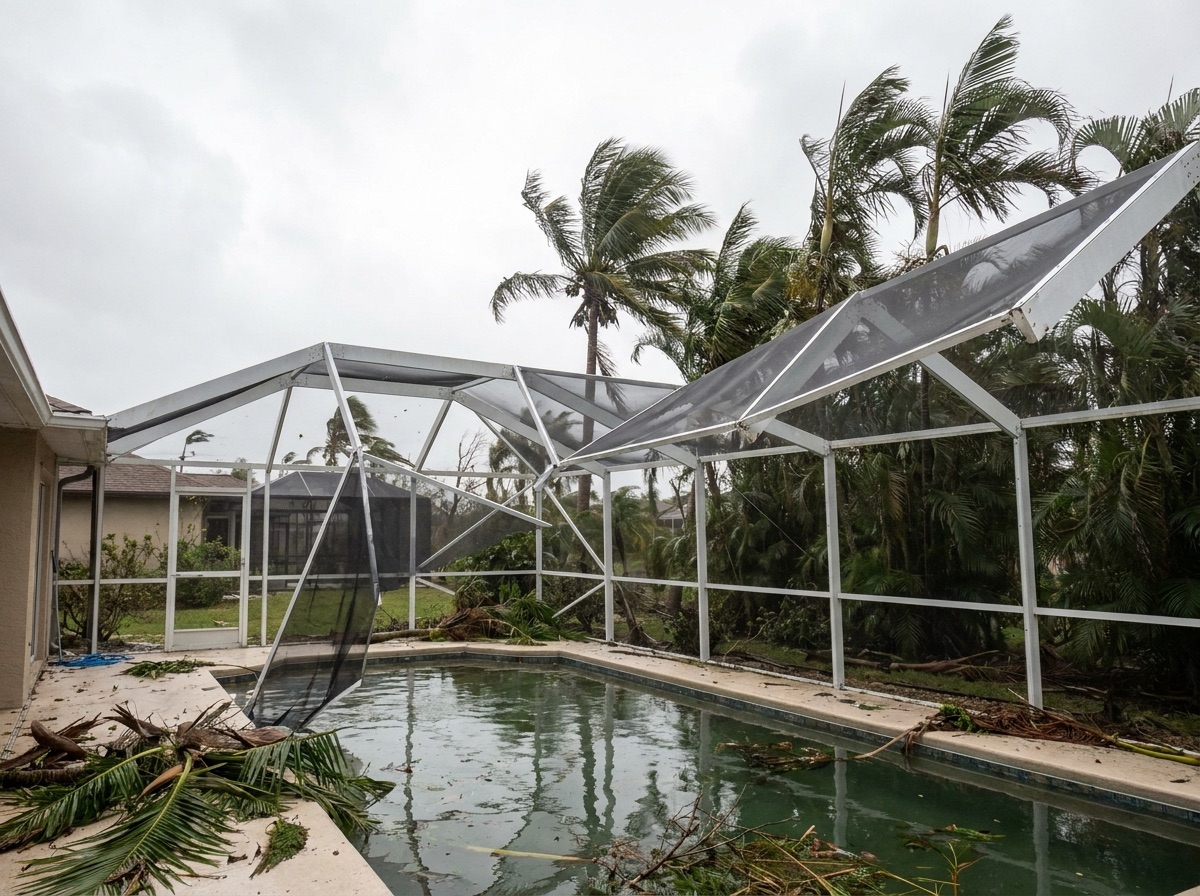
Screen Door Repair
Screen door repair covers fixes to the hinged, framed screen doors on pool cages, lanais, and screen rooms - the primary entry and exit points for the enclosure. In Florida's climate, screen doors endure more abuse than any other component of an enclosure: daily mechanical cycling, UV exposure, salt air, and direct hurricane loading.
Get matched for screen door
Free, no obligation. We match you with up to two licensed, insured local pros so you can compare.
- Licensed pros
- Free, no spam
- One call, not eight
Got it. You are in good hands.
A vetted local pro will reach out shortly. For an active emergency, call us now at (813) 555-0911.
Screen door repair covers fixes to the hinged, framed screen doors on pool cages, lanais, and screen rooms - the primary entry and exit points for the enclosure. In Florida's climate, screen doors endure more abuse than any other component of an enclosure: daily mechanical cycling, UV exposure, salt air, and direct hurricane loading. The most common failures are screen fabric tears in the door panel, bent or corroded aluminum door frames, broken or stiff door closers (both hydraulic and pneumatic styles), worn door hinges that allow the door to sag or drag, and failed latches or magnetic catches. Most screen door repairs are straightforward same-day work. Full door replacement - new aluminum frame, hardware, and screen fabricated and hung to fit the existing opening - is needed when the frame itself is bent beyond adjustment or has corroded through.
When you need itSigns you need this service
- The screen door has a tear, large hole, or is missing screen entirely
- The door does not close fully or latches only with significant force due to frame misalignment or a sagging hinge
- The hydraulic or pneumatic door closer is broken, leaking fluid, or no longer returning the door to closed position
- The door frame is visibly bent, corroded through, or has separated at a corner joint
- The door drags on the threshold or frame when opened and closed, indicating a hinge or alignment problem
- The door latch, magnetic catch, or strike plate is broken or corroded to the point of non-function
How it works
- Diagnosis - screen, hardware, or frameThe contractor identifies whether the problem is isolated to the screen fabric, is a hardware issue (closer, hinge, latch), or involves the aluminum door frame itself. This determines whether a repair or a full door replacement is the right scope - misdiagnosing a frame problem as a screen problem leads to repeat failures.
- Screen fabric repair or replacementIf only the screen is damaged and the frame is sound, the old screen and spline are removed from the door frame, new screen is cut and tensioned into the frame, and fresh spline is set. Door panels require particular attention to corner tension because the door flexes during operation in a way fixed panels do not.
- Hardware repair or replacementCloser, hinge, and latch issues are addressed as a separate scope from the screen. Hydraulic closers are replaced rather than repaired when they fail - the parts cost is minimal relative to the labor to remove and re-install. Hinges are adjusted or replaced. Latches and magnetic catches are replaced with matching or upgraded hardware.
- Frame alignment and adjustmentIf the door sags or binds in the opening, the frame alignment is checked against the fixed opening frame. Hinges are adjusted, and if the door frame itself is bent, straightening or replacement is determined. Minor bends can sometimes be cold-straightened on-site; significant bends or corner separation typically require a new door.
- Full door fabrication and installation (if needed)When a full replacement is required, the opening is measured precisely and a new aluminum frame is fabricated - either on-site or at a shop - to fit the existing opening. New screen is installed in the frame before hanging. The door is hung, leveled, and adjusted for smooth operation before hardware is installed.
- Final operation testThe repaired or replaced door is cycled through 20-30 open-close operations to confirm smooth operation, proper closer return speed, latch engagement, and that the door seals against the frame without gaps at top, bottom, or sides. Closer tension is adjusted to Florida code-required slow-close speed for pool safety if applicable.
What it costs
Screen-only door repairs - removing and replacing the fabric in a sound frame - typically run $75-$175. Hardware replacement (closer, hinges, latch) adds $50-$150 depending on parts. A full door replacement with new aluminum frame, screen, and all hardware installed runs $400-$1,200, with the range driven by door width, whether it is a single or double French-style door, and current aluminum material costs. Post-storm demand and the cost of premium materials like pet-resistant screen or heavy-duty closers push totals toward the higher end of these ranges.
Screen Door questions
How often do pool cage screen doors typically need replacement in Florida?
A well-maintained aluminum screen door on a Florida pool cage should last 10-20 years structurally. The screen fabric in the door panel typically needs replacement every 5-10 years, which is shorter than fixed cage panels because doors flex and see direct handling. Door closers are the most frequently replaced component - hydraulic closers typically last 5-10 years in Florida's heat and humidity before seals degrade and fluid leaks. Hinges and latches on quality aluminum doors can outlast multiple screen and closer replacements if maintained and kept free of salt-air corrosion.
What is the difference between a hydraulic and a pneumatic screen door closer?
Hydraulic closers use oil-filled cylinders to control return speed - they provide a smooth, adjustable close and are the most common type on Florida pool cage doors. Pneumatic closers use air compression and are simpler but offer less speed control. Both types are required to return the door to fully closed position to meet Florida pool barrier code, which mandates self-closing, self-latching doors on pool enclosures. When a hydraulic closer leaks, it typically either slams or no longer closes fully - both are signs of replacement, not repair.
Florida pool barrier law requires self-closing doors - what does this mean for my screen door?
Florida Statute 515 requires that all doors providing direct access to a swimming pool be self-closing and self-latching, with the latch located out of reach of young children. For screen enclosure doors, this means a functioning door closer that returns the door to fully closed position and a latch that engages automatically when the door closes. A screen door with a broken closer or a latch that does not engage is non-compliant and creates a genuine safety hazard - not just an inconvenience. This is one reason prompt repair of failed door hardware matters. Consult the full statute and your local code for specific requirements.
My screen door was bent by a storm - can it be straightened or does it need replacement?
Minor bends in the door frame - slight bowing in a rail or a small dent - can often be cold-straightened on-site by an experienced contractor, and the door can continue to function properly. When the corner joints have separated, an extrusion is cracked through its wall, or the bend is significant enough to prevent the door from seating in the opening frame without a persistent gap, replacement is the right call. A bent door that appears to close but leaves gaps at the corners is worse than a visibly broken one - it gives a false sense of security while letting insects and debris through.
What type of screen is best to use in a door panel?
Pet-resistant vinyl-coated polyester is the best choice for any household with dogs or cats, even if the animals rarely approach the door directly - they frequently lean or press against it in passing. For homes without pets, standard polyester is recommended over fiberglass for door panels because the flexibility and handling stress of daily door operation degrades fiberglass screen faster than it degrades fixed panels. Solar screen is not typically recommended for door panels because it significantly reduces visibility through the door, which creates navigation and safety issues.
The screen in my door is torn but the frame is fine. Can I just replace the screen myself?
A handy homeowner can replace screen in a door frame with the right tools: a spline roller, a utility knife, new screen mesh, and new rubber spline. The key challenge with door panels is achieving even tension across the full panel while the frame is held flat - doors tend to bow slightly when spline is driven in on one side before the opposite side is done. Lay the door frame flat on a hard surface while working, start at the center of each side, and work outward to distribute tension evenly. If the door is a non-standard size or has an unusual frame profile, buying matched spline from a screening supply house (not a big-box store) makes a significant difference in outcome.
How do I know if my door frame needs replacement versus just hardware repairs?
Walk the door frame perimeter and look for: corner joints that have opened up or are held only by the spline, extrusions that are visibly bowed or twisted along their length, corrosion pitting that has eaten through the metal wall of the extrusion, or any crack in the aluminum. If none of these are present and the door is simply not functioning well, the problem is almost certainly hardware - closer, hinges, or latch - which is a straightforward repair. When in doubt, a reputable contractor will give you an honest read on whether the frame is salvageable.
Can I upgrade to a double French-style screen door when I replace a single door?
Yes, provided the opening width accommodates a double door. Single doors on pool cages and lanais are typically 32-36 inches wide; a double door uses the same opening width with two narrower panels meeting at the center. Double doors are popular when moving larger items through the cage or for a more open visual appearance. The cost is higher - roughly $200-$500 more than a single door replacement - and the hardware is more complex, with a dual-point latch system required to meet self-latching code requirements. Your contractor should confirm the opening width and header condition before quoting a double door conversion.
What maintenance keeps screen doors operating well in Florida's climate?
Lubricate hinge pins and closer pivot points once a year with a light silicone spray - not WD-40, which attracts dust and gums up over time. Wipe salt and pollen buildup off the frame and hardware twice a year with a damp cloth. Test the closer return speed annually and adjust the closer's speed-control valve if the door is slamming or not fully closing. Inspect the corner joints of the door frame annually for any separation beginning. Keep the threshold clear of sand and debris that causes the door to drag, which stresses the bottom hinge over time.
A contractor told me my door needs replacement but another said it just needs new screen. Who is right?
Get a third opinion if the two assessments are in significant conflict. In general, if the frame is structurally sound - no cracked extrusions, no separated corners, no through-wall corrosion - and the door was functioning properly before the screen damage, screen-only replacement is almost always the correct scope. A recommendation to replace a structurally sound frame is worth questioning. Ask the contractor recommending replacement to point to specifically what on the frame makes it non-repairable. If they cannot point to a specific structural defect, screen replacement is likely the right answer.