Bathroom Mold Removal in St. Petersburg
Removal of mold from bathrooms and other high-humidity areas. We connect St. Petersburg homeowners with vetted, licensed local pros, free.
Bathroom Mold in St. Petersburg
Free, no obligation. We match you with up to two licensed, insured local pros so you can compare.
- Licensed pros
- Free, no spam
- One call, not eight
Got it. You are in good hands.
A vetted local pro will reach out shortly. For an active emergency, call us now at (813) 555-0911.
St. Petersburg homeowners turn to bathroom mold removal after the storms that hit Pinellas County. Here is exactly what the work involves, what it costs, and how to get matched with a local pro.
Bathrooms are the single most common location for household mold growth because they combine the three conditions mold requires: warmth, moisture, and organic material. Grout lines, caulk seams, drywall behind tile, the underside of bathroom flooring, and the cavity behind shower surrounds are all chronic problem zones. In Florida, where outdoor humidity keeps building envelope moisture levels elevated year-round, even well-ventilated bathrooms can harbor persistent mold. Illinois homes face the same issue seasonally - winter condensation on cold exterior bathroom walls creates wet surfaces that remain damp for days. Professional bathroom mold removal goes beyond scrubbing visible tile growth: a qualified remediation technician identifies whether mold has penetrated into drywall, cement board, or subfloor; removes and replaces any compromised substrate materials; treats framing and adjacent surfaces; and addresses the ventilation or waterproofing deficiency driving recurrence. Surface-only treatments without substrate assessment frequently result in regrowth within weeks.
When you need itSigns you need this service
- Black, green, or pink mold is visible on tile grout, caulk lines, or the ceiling of the bathroom
- Caulk around the tub or shower surround is discolored, soft, or separating from the wall
- The wall behind the shower or tub feels soft when pressed, or the tile sounds hollow when tapped
- Mold keeps returning within weeks of cleaning despite regular scrubbing and ventilation efforts
- You notice a persistent musty smell in the bathroom even after thorough cleaning
- The bathroom exhaust fan is undersized, non-functional, or vents into the attic rather than outside
How it works
- Moisture assessment and source identificationBefore removing anything, a technician uses a moisture meter and visual inspection to determine whether mold is limited to the surface (grout, caulk, paint) or has penetrated tile backer board, drywall, or subfloor. This distinction controls whether the job is a cleaning engagement or a partial demolition and replacement project.
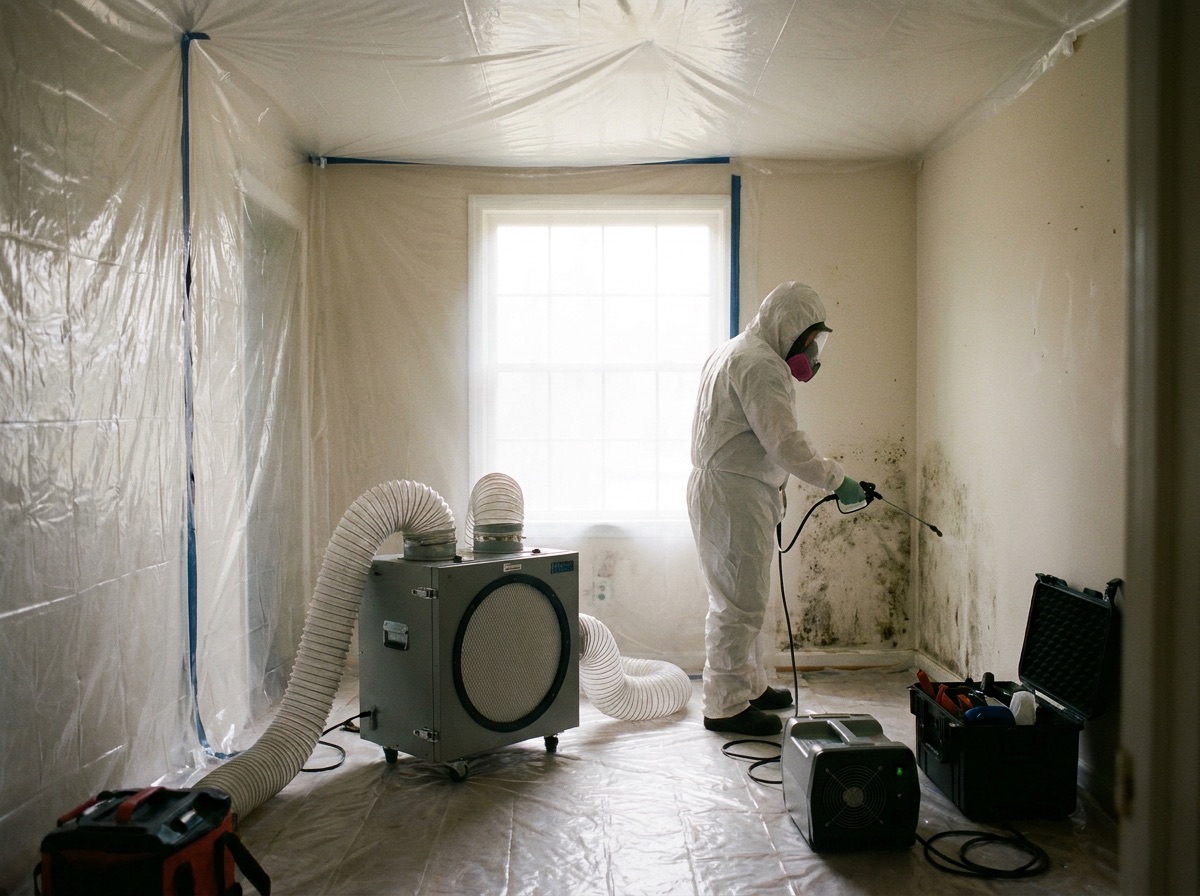
- Containment setupThe bathroom is sealed off with plastic sheeting and a HEPA air scrubber is placed to maintain negative air pressure. This prevents spores disturbed during cleaning and demolition from migrating into bedroom or hallway air.
- Removal of contaminated substrate materialsAny drywall, cement board, backer board, or subfloor material that has mold growth beyond the surface is removed and bagged for disposal. Attempting to clean mold from saturated drywall is ineffective - it must be cut out to a verified clean margin. Tile is removed only if the substrate beneath is compromised.
- Surface treatment with antimicrobialsRemaining structural surfaces (framing, concrete, tile) are wire-brushed, HEPA-vacuumed, and treated with an EPA-registered antimicrobial agent. In enclosed bathroom cavities, an encapsulant may be applied to framing after cleaning to provide a second barrier against residual spore germination.
- Drying and ventilation correctionThe cavity is dried with air movers until moisture readings are at or below acceptable levels. If the root cause is an inadequate or non-functional exhaust fan, this is the point where the contractor should document the finding and recommend a fan upgrade - typically 1 CFM per square foot of bathroom area, venting directly outdoors.
- Reconstruction and caulk/grout sealingReplacement of backer board, drywall, tile, and finish materials is either included in the remediation contract or completed by a separate tile or general contractor. Fresh mold-resistant caulk and properly sealed grout lines are the final protection layer. Using mold-resistant drywall (paperless or fiberglass-faced) in the replacement is standard in high-humidity applications.
What it costs
Surface bathroom mold removal - limited to grout, caulk, and paint - runs $500-$1,500. Once mold has penetrated backer board or drywall behind tile, costs rise to $2,000-$5,000 because tile demolition, substrate replacement, and reconstruction are required. Subfloor involvement (common around toilet flanges and tub edges where slow leaks go undetected) can push a bathroom project to $5,000-$8,000 or more. Florida coastal homes may face a premium due to higher baseline humidity complicating the drying phase, and Chicago-area projects may add costs during winter when ambient conditions slow structural drying.
Bathroom Mold in St. Petersburg: questions
Do you offer bathroom mold in St. Petersburg?
Yes. We connect St. Petersburg homeowners with vetted, licensed local pros for bathroom mold removal, with a free assessment and no obligation.
How fast can someone help with bathroom mold in St. Petersburg?
For St. Petersburg and the surrounding Pinellas County area, our network pros prioritize storm work and typically respond same-day or next-day for urgent needs.
Can I remove bathroom mold myself with bleach?
Bleach kills surface mold on non-porous materials like ceramic tile and glass. It does not penetrate porous surfaces like grout, caulk, drywall, or wood, so it removes the color of the mold (making it look clean) without eliminating the root structure. Mold treated with bleach on porous surfaces typically returns within days to weeks. Professional remediation is appropriate when growth is recurrent, covers more than 10 square feet (EPA guideline for DIY limits), or when you suspect penetration behind the wall surface.
Why does bathroom mold keep coming back even after cleaning?
Recurrence almost always means one of two things: the moisture source was not corrected, or the mold was removed from the surface but not from the substrate it has colonized. Common moisture sources that drive recurrence include an undersized or non-functional exhaust fan, a grout or caulk failure that allows water to reach the wall cavity, a slow drip behind the wall from a supply or drain fitting, or in Florida specifically, condensation from a cold-water supply pipe in a high-humidity environment. Fixing the visible mold without addressing the source is a temporary measure.
How do I know if the mold has gone behind the tiles?
Signs that mold has penetrated behind tile include: tile that sounds hollow when tapped (grout or adhesive has degraded, often from water intrusion), tile that moves or flexes when pressed, soft or springy drywall adjacent to the shower, discoloration appearing at the perimeter of the tile field on paint or drywall, and a persistent musty odor that does not resolve after surface cleaning. A professional moisture meter reading through the tile field will detect elevated readings in the substrate without tile removal.
Is bathroom mold dangerous to health?
Most bathroom mold belongs to common genera like Cladosporium, Aspergillus, or Penicillium, which are opportunistic rather than acutely toxic. However, any active mold colony produces spores and mycotoxins at varying levels. Prolonged exposure in an enclosed space like a small bathroom - particularly for occupants with asthma, allergies, compromised immune systems, or young children - is a legitimate health concern. Stachybotrys (black mold) requires sustained saturation of cellulose-based materials to grow, making it less common in bathroom surfaces but possible in chronically wet wall cavities.
How do professionals keep mold from coming back after treatment?
Durable outcomes require three simultaneous actions: eliminate the mold colony through removal and antimicrobial treatment, replace compromised substrate with moisture-resistant materials, and correct the moisture source. Long-term prevention in bathrooms depends on reliable exhaust ventilation (run the fan during every shower and for 20-30 minutes afterward), intact grout and caulk seals inspected annually, a properly functioning exhaust fan that vents outdoors, and in Florida, maintaining indoor AC to keep relative humidity below 60%.
What is the difference between mold-resistant drywall and regular drywall?
Standard drywall has a paper facing that mold can colonize directly. Mold-resistant drywall uses a fiberglass mat or paperless facing that denies mold the organic substrate it needs to grow on the surface. It also typically incorporates additives in the gypsum core. In bathroom rebuilds following mold remediation, using mold-resistant or cement board products rather than standard drywall is a meaningful upgrade that reduces the risk of recurrence - particularly in Florida where ambient humidity is persistently high.
Does homeowners insurance cover bathroom mold removal?
Coverage depends on the cause. If the mold resulted from a sudden, accidental event covered by the policy - such as a supply line burst - the resulting mold remediation is generally covered subject to any mold sublimit in the policy. Mold that developed gradually from a slow undetected leak, condensation, or inadequate ventilation is typically excluded as a maintenance issue. Florida homeowners should review their policy's mold sublimit carefully, as many carriers cap mold coverage at $5,000-$10,000, which may not cover a full tile-demolition and substrate-replacement project.
How long does bathroom mold removal take?
A surface-only treatment of grout, caulk, and accessible tile can typically be completed in a few hours to one day. A project requiring tile demolition, substrate removal, structural drying, and reconstruction typically runs 3-7 days - with the drying phase (usually 2-3 days with air movers and dehumidifiers) being the longest step that cannot be shortened without risking recurrence.
Does the toilet area require separate treatment from the shower area?
Yes, the base of the toilet is a chronically high-risk zone distinct from the shower surround. The wax ring seal between the toilet flange and the toilet base degrades over time, allowing slow seepage of water and sewage into the subfloor. Mold in this area often involves contaminated (Category 3) water, which requires full biohazard protocol and complete subfloor replacement in the affected area. If mold is visible at the base of the toilet or the floor feels soft nearby, that area requires specific assessment separate from the shower walls.
What exhaust fan size do I need to prevent mold recurrence in my bathroom?
The standard rule is 1 CFM (cubic feet per minute) of exhaust capacity per square foot of bathroom floor area - so a 60-square-foot bathroom needs at minimum a 60 CFM fan. For bathrooms with a separate toilet compartment or jetted tub, the HVI (Home Ventilation Institute) recommends sizing up. The fan must vent directly to the exterior, not into an attic or crawl space - a common installation error found particularly in older Florida construction that creates an attic mold problem in addition to the bathroom problem.