Impact Window & Door Replacement in The Villages
Storm-broken windows leave your home exposed and unsecured. Storm Damage 911 connects you with licensed window and door contractors who replace damaged units with Florida-code impact-rated glass, with a free measurement and estimate.
Impact Windows in The Villages
Free, no obligation. We match you with up to two licensed, insured local pros so you can compare.
- Licensed pros
- Free, no spam
- One call, not eight
Got it. You are in good hands.
A vetted local pro will reach out shortly. For an active emergency, call us now at (813) 555-0911.
Impact Windows after storms in The Villages
Sumter County is an inland county in central Florida, making inland flooding and high winds the dominant storm threats rather than coastal surge. During hurricane season (June through November), tropical cyclones tracking across or near the peninsula deliver sustained tropical-storm-force winds, wind-driven debris damage, and heavy rainfall that overwhelms the county's low-lying areas and rural roads - Hurricane Irma (2017) caused roughly $5.9 million in damage, with a peak gust of 61 mph recorded in The Villages and approximately $5 million in flood losses. Hurricanes Helene and Milton (2024) displaced 658 residents, required debris clearing on over 195 county roads, and produced widespread flooding and structural damage. Virtually all landfalling Florida hurricanes also spawn tornadoes, with the right-front quadrant of a storm presenting the greatest tornado risk, and the county's large retirement-age population amplifies recovery demands following any significant storm event.
That is why matching with a pro who actually works in Sumter County matters. The impact windows specialists in our The Villages network are licensed for this trade, insured, and locally rated, and they give you a free, written assessment with no obligation.
Impact window and door replacement in Florida is not cosmetic - it is a code-compliance and life-safety upgrade governed by the Florida Building Code (8th Edition, 2023) and, in Miami-Dade and Broward counties, the High-Velocity Hurricane Zone (HVHZ) requirements. Any home in Florida's Wind-Borne Debris Region (areas with ultimate design wind speeds above 140 mph, or within one mile of the coast at 130 mph) must protect all openings with products that pass large-missile impact testing: a 9-lb 2x4 launched at 50 fps, followed by 9,000 pressure cycles. HVHZ products must carry a Miami-Dade Notice of Acceptance (NOA) in addition to Florida Product Approval. After storm damage, replacement requires a permit before work begins, licensed contractor installation, and a municipal inspection before the permit closes. Costs run $800-$3,800 per window installed. Custom fabrication for code-compliant units adds 4-6 weeks to the project. Homeowners in eligible income brackets can offset costs through the My Safe Florida Home grant program (up to $10,000 for the 2025-2026 cycle).
The processHow impact window & door replacement in The Villages works, step by step
- Site assessment and measurementThe contractor inspects each opening for frame condition, rough opening dimensions, anchor substrate (CBS block vs. wood frame), and existing product approval documentation. In HVHZ counties, they confirm whether the existing NOA is still current. Storm-damaged units are photographed for insurance documentation before removal.
- Permit application and product approval submissionThe contractor pulls a building permit with the municipality, submitting the Florida Product Approval number (or Miami-Dade NOA for HVHZ) for each unit. Permit review takes 5-10 business days in most cities, up to 30-50 days in some unincorporated county jurisdictions. Work cannot legally begin before permit issuance.
- Custom fabrication and orderImpact windows are manufactured to the exact rough opening dimensions. Standard residential units run 4-6 weeks from order to delivery. Custom shapes, specialty glass (SGP interlayer, triple-pane IGU, decorative grids) extend lead time. Fabrication delays from import tariff disruptions in 2025-2026 have added 1-2 weeks for aluminum-frame products.
- Existing window and door removalInstallers remove the existing units, taking care not to damage the rough opening or surrounding stucco/drywall. Storm-damaged frames may require partial frame repair or buck installation before the new unit can be set. Debris is collected and disposed of same day.
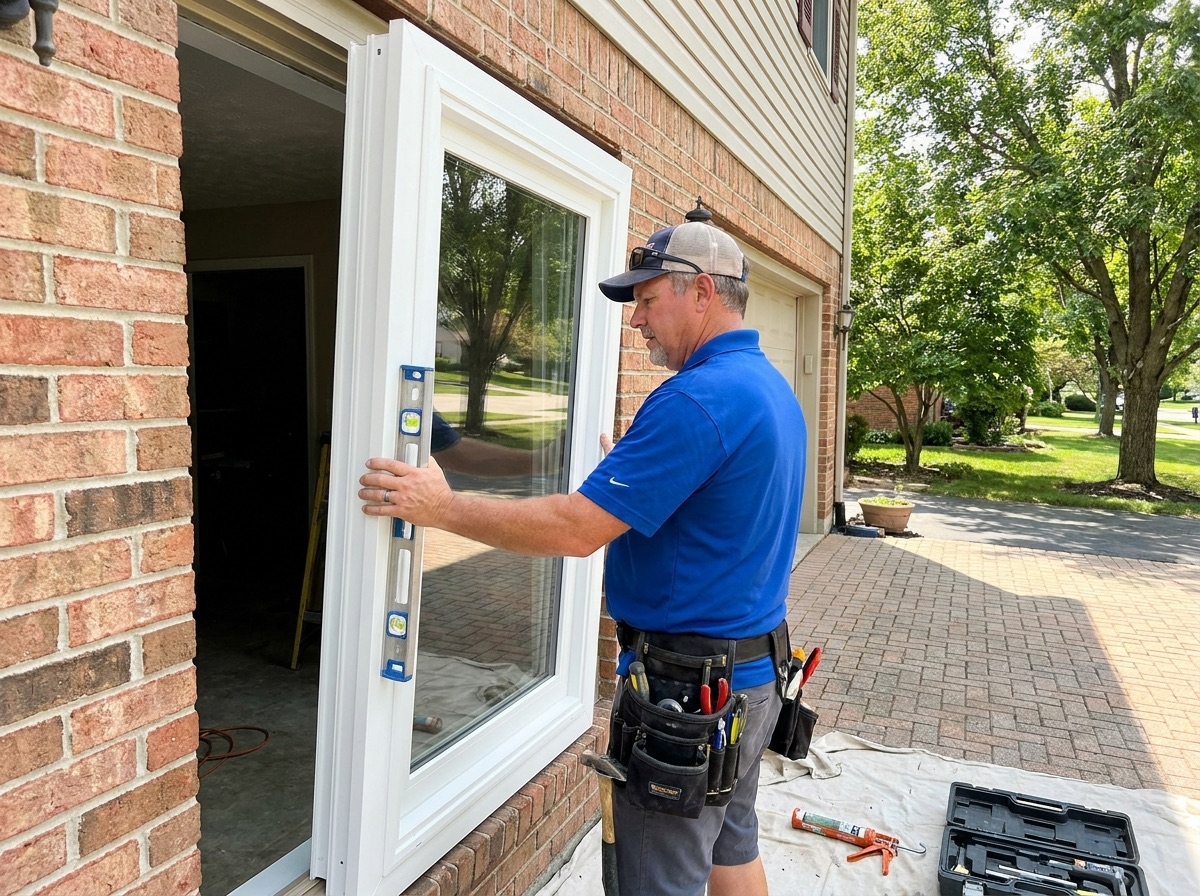
- Installation and anchoringNew units are set into the opening, shimmed level and plumb, and anchored using the fastener type, diameter, and spacing specified in the approved product's installation drawings. In HVHZ, fastener pattern must match the NOA exactly - substitutions void the approval. Improper spacing is one of the leading causes of field failure during storms.
- Weatherproofing and sealingInstallers apply code-required perimeter sealant (typically a low-modulus, paintable silicone or polyurethane approved for the substrate) at the interior and exterior perimeter. Flashing tape or flashing membrane is integrated at the sill to meet water-infiltration test standards. Stucco patching around the perimeter is typically the homeowner's responsibility unless specified in the contract.
- Final inspection and permit closeA municipal inspector visits to verify model numbers against the permit, confirm fastener pattern, check sealant installation, and ensure operation of all operable units. Once the inspection passes, the permit is closed. Most Florida jurisdictions void permits if no inspection occurs within 180 days of issuance. The homeowner should receive a copy of the closed permit for their records and wind mitigation report.
- Wind mitigation inspection (optional but recommended)After permit close, the homeowner can commission a licensed wind mitigation inspector to document the impact-rated openings. The resulting OIR-B1-1802 wind mitigation report is submitted to the insurer to trigger premium discounts, which can run 5%-20% on the windstorm portion of the policy.
Cost factors
- Window count and home size. A single storm-damaged replacement runs $800-$3,800 installed. Full-home projects covering 15-20 windows typically run $12,000-$25,000+, with per-unit pricing declining modestly at higher quantities due to mobilization efficiency.
- Frame material. Aluminum frames are the Florida market standard - corrosion-resistant and code-common - ranging $1,000-$2,500 per window installed. Vinyl frames run $800-$1,800 and are less exposed to 2025-2026 import tariff pressure (4-6% increase vs. 8-15% for aluminum). Fiberglass frames are premium at $1,500-$3,800 and offer superior thermal performance.
- Glass package and interlayer. Standard PVB (polyvinyl butyral) laminated glass meets Florida code for most residential applications. SGP (SentryGlas Plus) interlayer - offering five times the tear strength of PVB - is a premium upgrade running $200-$600 more per unit. Insulated laminated glass (IGU) with Low-E coating adds energy performance and increases cost by $150-$400 per unit.
- HVHZ vs. non-HVHZ location. Products installed in Miami-Dade or Broward HVHZ must carry a current Miami-Dade NOA, which limits the approved product catalog. HVHZ-rated units typically cost 10-20% more than equivalent non-HVHZ units due to more stringent testing and smaller approved supply pool.
- Opening size and type. Standard double-hung or single-hung windows (24"x36" to 36"x60") are least expensive. Sliding glass doors run $2,500-$6,000 installed. French doors and entry doors run $1,500-$5,000 per unit. Oversized, arched, or custom-shape openings can reach $4,000-$8,000 per unit for fabrication alone.
- Frame condition and rough opening repair. Replacing windows in good masonry openings adds minimal prep cost. Storm-damaged or rotted bucks, deteriorated lintels, or openings requiring new structural framing can add $300-$1,500 per opening in prep labor before the new unit can be installed.
- Permitting fees and municipality. Permit fees vary by jurisdiction but typically add $200-$800 for a full-home project in Florida. Some municipalities expedite permit reviews for a fee. Unincorporated county review can take 30-50 days, extending the overall project timeline.
- Labor and market conditions. South Florida (Miami-Dade, Broward, Palm Beach) commands a 15-25% labor premium over Central or North Florida markets due to contractor demand and HVHZ complexity. Post-storm surge pricing following major hurricane events can temporarily increase labor costs 20-40% in affected areas.
Your options
- PVB laminated glass (standard). Polyvinyl butyral interlayer bonded between two lites of heat-strengthened glass. Meets Florida Building Code for residential applications. Standard 5/16" construction provides design pressure ratings around +65/-65 psf (~161 mph wind resistance). Most cost-effective code-compliant option.
- SGP (SentryGlas Plus) laminated glass. Structural ionoplast interlayer with five times the tear strength of PVB and twice the load-bearing capacity at the same thickness. Specified for high-rise, HVHZ commercial, and essential facility applications. Adds $200-$600 per unit. Post-breakage residual strength is significantly higher.
- Insulated laminated glass unit (IGU). Laminated impact pane combined with an additional glass lite and air or argon-gas space for thermal insulation. Low-E coating on the inner pane reduces solar heat gain - relevant in Florida where cooling loads dominate. Adds $150-$400 per unit; can meaningfully reduce utility bills in large homes.
- Aluminum frame. Industry standard in coastal Florida. Corrosion-resistant, dimensionally stable, widely approved under Florida Product Approval and Miami-Dade NOA. Thinner sightlines than vinyl. Thermally broken aluminum frames reduce conductive heat transfer.
- Vinyl (uPVC) frame. Lower cost, good thermal performance, no painting required. Less exposed to 2025-2026 aluminum tariff pressure. Less common in HVHZ due to a smaller NOA-approved product set. Can become brittle over time in extreme UV exposure.
- Fiberglass frame. Premium option. Expansion coefficient matches glass closely, reducing seal stress over decades. Paintable, durable in salt-air environments. Least common but best long-term performance in coastal applications.
- Laminated low-E coating with tint. Tinted glass or spectrally selective Low-E coatings reduce visible light and/or solar heat gain. Relevant for Florida west- and south-facing exposures. HOA approval may be required for exterior appearance changes.
When to call a pro
- Visible cracks, chips, or delamination in the glass laminate - even if the pane did not fall out, a compromised laminate has lost its impact resistance and will not meet code or pass inspection.
- Condensation or foggy haze trapped between the glass panes, indicating the insulated unit seal has failed and the inert gas has been replaced by humid air.
- Water intrusion at the window perimeter during rain or after a storm, which points to failed sealant, compromised flashing, or frame damage that will worsen with each weather event.
- Visible frame damage: bent, bowed, or cracked aluminum or vinyl frames after a storm event, particularly at corners where racking stress concentrates.
- Drafts around closed windows - air infiltration around a supposedly sealed impact unit indicates frame distortion or sealant failure that also allows water entry.
- Existing windows lack a Florida Product Approval sticker or Miami-Dade NOA (in HVHZ counties), meaning they were installed without proper documentation and may not meet current code - a problem discovered at resale, during re-roofing permits, or after a claim.
- Difficulty operating operable units - sashes that stick, slide hard, or no longer lock properly may have frame distortion from wind load or impact, and a window that does not close and lock fully provides no storm protection.
- The home still has single-pane, plate glass, or non-laminated windows - these provide no meaningful wind-borne debris protection and are non-compliant in Florida's Wind-Borne Debris Region.
How insurance typically works
EDUCATIONAL ONLY - this is general information, not claim advice, legal advice, or a recommendation to file or not file a claim. Florida homeowners insurance policies generally cover sudden, accidental storm damage to windows and doors under the dwelling coverage (Coverage A). A standard deductible (typically $1,000-$2,500) applies to most loss types. A separate hurricane deductible - typically 2%-5% of the home's insured value, not a flat dollar amount - applies when a state of emergency or hurricane watch/warning is active and continues for 72 hours after it ends under Florida law (F.S. 627.712). The homeowner is responsible for paying their full applicable deductible. Under Florida Statute 489.147, it is a third-degree felony for a contractor to knowingly pay, waive, or rebate all or part of an insurance deductible as an inducement to perform work. Any contractor who offers to "cover your deductible" or "work around your deductible" is asking you to participate in insurance fraud. Filing a claim for damage that did not occur, or inflating the scope of a claim, is also insurance fraud under Florida law. Insurers are required by Florida law to offer premium discounts for verified wind mitigation features including impact-rated openings - a legitimate benefit separate from any claim process, accessed through a licensed wind mitigation inspector and the OIR-B1-1802 report form.
How to choose the right pro
- Verify state license: Confirm the contractor holds a current Florida Certified Glass and Glazing Contractor license or Certified Window and Door Installation Specialty Contractor license at the Florida DBPR license verification portal (myfloridalicense.com). As of July 1, 2025, locally registered specialty licenses are no longer acceptable substitutes for state certification.
- Confirm the contractor pulls the permit: Florida law requires a permit for all impact window replacements. A contractor who suggests 'we can skip the permit' is asking you to accept an unlicensed, uninspected installation - which voids warranties, creates resale problems, and can result in an insurance claim denial.
- Request product approval documentation before signing: Ask for the Florida Product Approval number for every window and door being installed. In Miami-Dade or Broward HVHZ, ask for the current Miami-Dade NOA. Confirm the product is approved for your opening size and design pressure requirements.
- Check insurance certificates: The contractor should carry current general liability insurance and workers' compensation coverage (or valid exemption). Ask for certificates naming you as additional insured for the duration of the project.
- Ask about the installation drawings: Code-compliant installation requires following the product's approved installation drawings exactly - fastener type, size, spacing, and embedment depth. Ask whether the crew will work from those drawings on-site.
- Get a written scope of work and timeline: The contract should specify the exact product model numbers, Florida Product Approval numbers, permit responsibility, fabrication lead time, installation schedule, and who is responsible for stucco patching and interior trim.
- Ask about post-installation support: If the permit inspection fails, who is responsible for correction at no additional charge? What is the contractor's warranty on installation labor, separate from the manufacturer's product warranty?
- Verify references and active complaint history: Check the Florida DBPR for disciplinary actions on the license. Ask for at least two recent project references in your county, particularly for HVHZ work if applicable.
What is warrantied
Impact window warranties operate on two separate tracks. The product manufacturer typically provides a limited lifetime warranty on the frame and glass unit covering defects in materials and workmanship - coverage on seals, hardware, and finish varies by brand, and most warranties exclude damage from storm events (the glass is designed to crack while holding together, which is correct performance, not a defect). Interlayer (PVB or SGP) warranties typically run 10 years against delamination. The installation contractor provides a separate labor warranty on their workmanship, typically 1-5 years depending on the contractor; this covers leaks, fastener failure, and improper sealing attributable to installation error. Florida's implied warranty of habitability and the Florida Contractor's Recovery Fund (for licensed contractors) provide additional homeowner protections. Manufacturer warranties are typically transferable to subsequent homeowners with registration, which adds value at resale. Warranties are voided by unpermitted installation, deviation from approved installation drawings, or DIY repairs to the units.
Avoid theseCommon mistakes
- Hiring based on price alone: The lowest bid frequently reflects an unlicensed subcontractor, non-NOA products, or a plan to skip the permit. In Florida's regulated impact window market, a meaningfully lower price almost always indicates a corner being cut somewhere in the code-compliance chain.
- Allowing work to start before the permit is issued: Florida Building Code requires a permit before work begins, not after. Starting without a permit can result in a stop-work order, required removal of installed windows, and reinspection fees - plus insurance claim denial for any subsequent storm damage to unpermitted work.
- Not verifying the product approval for your specific opening: Florida Product Approval and Miami-Dade NOA approvals are size- and configuration-specific. A product approved for a 36"x48" opening is not automatically approved at 48"x72". Installers who use a product outside its tested size range create a code violation even with an otherwise valid approval number.
- Skipping the wind mitigation inspection after installation: The permit close does not automatically trigger the insurance discount. Homeowners must separately commission a licensed wind mitigation inspector, obtain the OIR-B1-1802 report, and submit it to their insurer. Skipping this step leaves money on the table every policy year.
- Assuming impact windows eliminate the need for hurricane shutters statewide: Impact windows are code-compliant opening protection in Florida's Wind-Borne Debris Region and HVHZ - you do not also need shutters. However, if any non-impact openings remain (skylights, garage doors without NOA), those openings still require protection.
- Ignoring the deductible responsibility: Some homeowners sign contracts based on a contractor's implied or explicit suggestion that the insurance proceeds will cover everything. The homeowner is legally responsible for their deductible. Any agreement - verbal or written - in which a contractor offers to absorb, waive, or work around the deductible is a felony under Florida Statute 489.147, and the homeowner who participates can also be liable for insurance fraud.
Impact Windows in The Villages: questions
Do you cover The Villages and nearby areas?
Yes. We match impact windows requests across The Villages and all of Sumter County. The pro we connect you with is local and licensed to work in your area.
How fast can a impact windows pro reach me in The Villages?
For The Villages homes, network pros usually schedule a free assessment within a day or two, faster during active storm response.
Are impact windows required by Florida law?
In Florida's designated Wind-Borne Debris Region - which covers most coastal counties and all areas with ultimate design wind speeds above 140 mph - all openings must be protected by either impact-rated products or approved storm shutters. In Miami-Dade and Broward counties (HVHZ), impact-rated products or equivalent shutters are required for all new construction and any replacement work. Outside the Wind-Borne Debris Region, standard windows remain permissible but impact windows are still widely installed for insurance discount and storm-protection purposes.
What is the difference between impact windows and hurricane windows?
The terms refer to the same product. 'Impact window' and 'hurricane window' are interchangeable marketing terms for windows that meet ASTM E1886/E1996 large-missile or small-missile impact testing standards, as incorporated into the Florida Building Code and Miami-Dade NOA testing protocols. The defining feature is laminated glass - two or more lites bonded with a PVB or SGP interlayer - combined with a frame system that maintains structural integrity under both impact and repeated wind-pressure cycling.
Will impact windows completely shatter during a hurricane?
No, and that is the design intent. If struck by debris, the outer glass lite cracks, but the laminated interlayer holds the broken glass in place, maintaining the building envelope. The window may crack and look broken while still functioning as an effective barrier against wind and water. A cracked unit should be replaced after the storm, but it does its job during the event. This is distinct from a failed window, where the unit separates from the frame - which is an installation failure, not a glass failure.
Do impact windows require a permit in Florida?
Yes, without exception. Florida Building Code Section 105.1 requires a permit for any replacement that alters the building envelope, and impact window replacement always qualifies. The permit requires submission of the Florida Product Approval number (and Miami-Dade NOA in HVHZ) for each unit. After installation, a municipal inspector must sign off before the permit closes. Skipping the permit creates resale complications, can void manufacturer warranties, and gives an insurer grounds to deny a storm damage claim.
How long does impact window installation take from start to finish?
The full timeline from contract signing to closed permit is typically 8-12 weeks. The breakdown: approximately one week for measurement and contract finalization; 2-5 weeks for permit review (faster in cities, slower in some unincorporated county jurisdictions); 4-6 weeks for custom fabrication and delivery; 1-4 days of active installation depending on home size; and approximately one week to schedule and complete the final municipal inspection. Homeowners often underestimate the fabrication lead time - these are custom-sized units, not stock items pulled from a warehouse.
What is an NOA and why does it matter?
NOA stands for Notice of Acceptance, a product approval issued by Miami-Dade County's Product Control Division. It is required for all exterior building envelope products installed in the High-Velocity Hurricane Zone (Miami-Dade and Broward counties), in addition to Florida statewide Product Approval. An NOA certifies that a specific product - at specific sizes, with specific anchorage - has passed Miami-Dade's rigorous large-missile and pressure cycling tests. If a contractor installs a product in HVHZ that only has Florida Product Approval but no current NOA, the installation is not code-compliant, regardless of how good the product is.
Can I get my insurance company to pay for impact window replacement after a storm?
Whether to file a claim is a decision only the homeowner can make based on their specific policy, deductible, and the nature of the damage. Generally, Florida homeowners insurance covers sudden, accidental storm damage to windows. If the damage was caused by a named hurricane, the hurricane deductible (often 2%-5% of Coverage A, not a flat dollar amount) applies instead of the standard deductible. The homeowner is responsible for the full deductible amount - a contractor who offers to waive or absorb it is committing a felony under Florida Statute 489.147. Document all damage with photographs before any temporary repairs, and review your policy's claim filing deadlines (initial claims within 1 year of loss; supplemental claims within 18 months under current Florida law).
What is the My Safe Florida Home grant and do I qualify?
My Safe Florida Home is a state-funded program that provides grants for wind mitigation improvements including impact windows. For the 2025-2026 funding cycle, the state appropriated $352 million. Grants are available up to $10,000 on a 2:1 matching basis (state contributes $2 for every $1 you spend). For the 2025-2026 cycle, eligibility is limited to homeowners with household income at or below 120% of their county's median income; low-income applicants (at or below 80% of median) receive priority and may qualify for up to $10,000 without the matching requirement. Applicants must first complete a free state-funded wind mitigation inspection to identify improvements. Check mysafefloridahomeprogram.org for current application status.
What is the difference between PVB and SGP interlayer glass?
Both are laminated interlayer materials that bond the glass lites together and hold the pane intact after impact. PVB (polyvinyl butyral) is the standard residential option - it meets Florida code for wind-borne debris protection and is cost-effective. SGP (SentryGlas Plus, an ionoplast interlayer) has five times the tear strength and twice the load-bearing capacity of PVB at the same thickness. SGP is typically specified for high-rise commercial buildings, essential facilities, and applications where maximum post-breakage structural performance is required. For most Florida single-family residential replacements, PVB laminated glass in a code-approved frame provides adequate protection.
Do impact windows reduce my homeowners insurance premium?
Florida law requires insurers to offer premium discounts for verified wind mitigation features, including impact-rated openings. The discount applies to the windstorm portion of the premium and typically runs 5%-20% depending on the insurer, the home's construction type, and how many openings are upgraded. To receive the discount, the homeowner must commission a licensed wind mitigation inspector, obtain the OIR-B1-1802 report documenting the impact-rated openings, and submit it to the insurer. The discount compounds over years, and on policies with large windstorm premiums (common in coastal South Florida), the annual savings can be meaningful relative to the installation cost.
Can impact windows be repaired, or must they always be replaced?
It depends on what failed. Hardware - locks, operators, rollers on sliding units - can typically be repaired or replaced without replacing the entire window unit. A failed insulated glass unit seal (indicated by fogging between panes) may allow the glass unit to be replaced within the existing frame if the frame is undamaged and the replacement unit carries the same product approval. A cracked or broken laminated pane almost always requires full unit replacement, because the impact resistance of cracked laminated glass is compromised and cannot be certified. Frame damage from storm racking or impact typically requires full unit replacement. Any repair work that replaces the glass unit requires a permit in Florida.
What should I do temporarily if my window is broken after a storm?
Temporary board-up with plywood or OSB (minimum 7/16" OSB or 1/2" plywood, properly fastened to the framing) is the standard approach for securing a broken opening until permanent replacement. Do not attempt to cover the opening with tarps alone in an active weather pattern - wind can get behind a tarp and create positive pressure. Document all damage with photographs and video before temporary repairs, as the documentation supports any subsequent insurance claim. Notify your insurer promptly - Florida law currently requires initial claims to be filed within 1 year of the date of loss. Temporary repairs are covered costs under most policies' 'reasonable repairs to protect the property' provisions.
Do impact windows also reduce noise and energy costs?
Yes, both are documented benefits beyond storm protection. The laminated glass construction provides meaningful sound attenuation - typically 5-10 dB better than standard single-pane glass, and combined with Low-E coating and an IGU (insulated glass unit) configuration, the reduction can be 10-15 dB, which is noticeable in highway or airport noise environments. On energy, Low-E coated laminated IGU impact windows reduce solar heat gain coefficient (SHGC) significantly compared to single-pane glass, which reduces cooling loads in Florida's climate. The actual energy savings depend on the existing windows being replaced, orientation of the openings, and HVAC system - they are real but variable.
What questions should I ask before signing a contract?
Ask: (1) What is the Florida Product Approval number for each unit, and is it current? In HVHZ, also ask for the Miami-Dade NOA number. (2) Will you pull the permit before starting work, and is that included in the quoted price? (3) What are the exact product model, frame material, glass package, and design pressure rating for each opening? (4) Who is responsible for stucco patching, interior trim, and cleanup? (5) What is the fabrication lead time in current market conditions, and what happens if delivery is delayed? (6) What is your installation labor warranty and how are post-installation leaks handled? (7) Is your license in the Glass and Glazing Contractor or Window and Door Installation Specialty Contractor category, and can I verify it at the DBPR portal?
Can I install impact windows myself in Florida?
Homeowners in Florida can pull their own permits for work on their primary residence, but impact window installation carries significant risk if done without professional experience. The installation must follow the product's approved installation drawings exactly - including fastener type (typically 3/16" or 1/4" Tapcon screws or equivalent), spacing, and embedment depth into masonry or wood framing. Errors void the product warranty, fail municipal inspection, and can result in windows that detach during a storm. An improperly installed window can also invalidate an insurance claim for storm damage. For most homeowners, the permit, fabrication, and inspection process is straightforward - the technical risk is in the installation itself, not the paperwork.